Scroll through Instagram on any given day and you’ll find college students breaking down Supreme Court judgments, teenagers debating reservations in comment sections, and twenty-somethings passionately arguing about capitalism, climate change, caste, gender, and state power. Political awareness is no longer rare among Indian youth—it’s almost expected.
And yet—
when it comes to actually shaping political outcomes, influencing policy, or feeling meaningfully represented, this same generation often feels strangely… powerless.
This contradiction sits at the heart of what I call the Indian youth paradox : politically alert, socially vocal, but institutionally sidelined.
Awareness Everywhere, Agency Nowhere
There is no denying that access to information has changed the landscape. Independent digital media, social platforms, podcasts, and even meme pages have turned political discussion into everyday conversation. For many young Indians, politics is no longer something you “study”—it’s something you constantly engage with.
A student attending online classes during the pandemic didn’t just experience poor connectivity; they also understood structural inequality in access to education. A first-time voter doesn’t just know who they voted for, but also debates why that choice matters.
But awareness alone doesn’t automatically translate into power.
Knowing what is wrong does not always mean knowing where or how to intervene. Most young people are informed, but not embedded—spectators to a political system that feels distant, bureaucratic, and largely unresponsive.
From Protest to Policy: The Missing Link
Take student protests as an example.
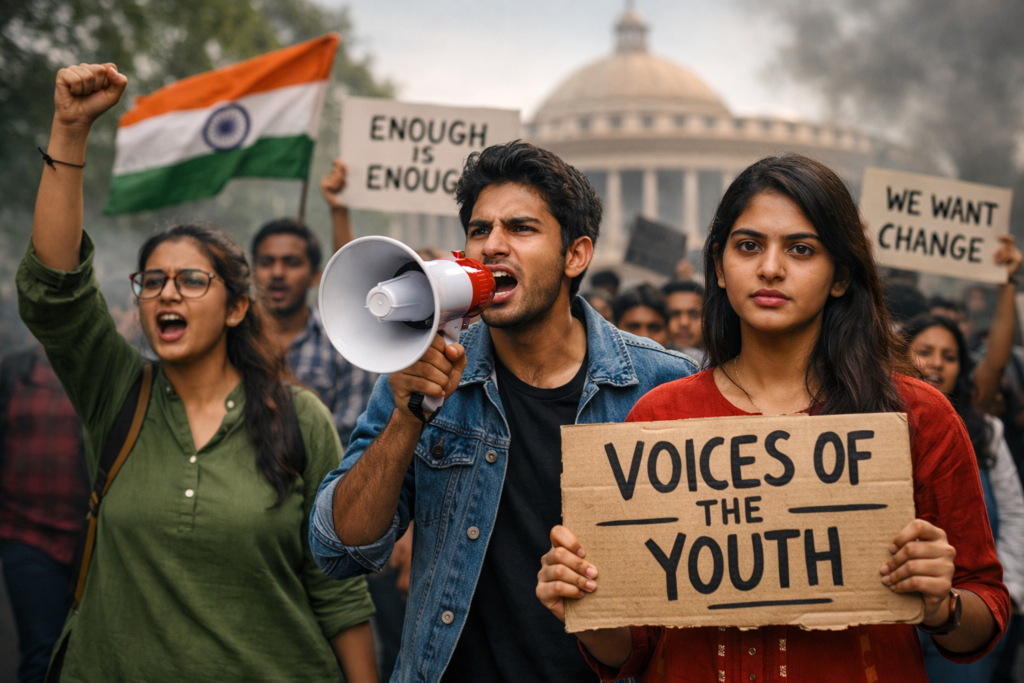
Across Indian universities, students routinely mobilise around issues like fee hikes, campus safety, discriminatory policies, and freedom of expression. These movements generate visibility, media coverage, and temporary pressure.
But what happens after?
Very rarely do these protests translate into long-term institutional reform. Committees are formed, assurances are given, and over time, momentum fades. Students graduate, leadership changes, and the system resets—largely unchanged.
The problem isn’t apathy. It’s the absence of clear pathways from protest to policy.
Young people are encouraged to raise their voices, but not equipped with mechanisms to sustain influence.
The Illusion of Participation
India loves the language of youth participation. Political parties speak of “young India,” ministries launch youth-focused campaigns, and consultations are organised to “hear student voices.”
But participation is often symbolic rather than substantive.
Student wings of political parties exist across ideological lines, but decision-making power remains heavily centralised. Youth leaders are mobilised during campaigns, yet rarely included in strategic discussions. Even advisory bodies tend to function as consultative spaces, not decision-making ones.
You are invited to speak—but not necessarily to decide.
This creates an illusion of inclusion, where engagement is visible but impact remains limited.
Voting Feels Important—But Incomplete
For many young Indians, voting is treated as the ultimate act of participation. And while voting is crucial, it is also episodic. Once every five years, you make a choice—and then wait.
In the years in between, accountability feels abstract. There are few accessible channels to question representatives, influence local governance, or participate in policy discussions meaningfully.
As a result, democracy begins to feel procedural rather than participatory.You do your duty—but don’t feel heard.
Social Media: Empowerment or Exhaustion?
Social media complicates this paradox further.
On one hand, it has democratised political expression. A tweet can reach thousands. A reel can spark national debate. Marginalised voices have found visibility outside traditional gatekeepers.
On the other hand, it has created a culture of constant outrage.
Being politically aware today often means being perpetually informed, perpetually angry, and perpetually expected to react. There is little room for reflection—only instant opinions.
Over time, this leads to exhaustion.
When every issue demands emotional investment, and few lead to tangible outcomes, awareness begins to feel like a burden rather than a tool.
And fatigue quietly turns concern into disengagement.
Institutions That Struggle to Speak Youth
Another reason this paradox persists lies in how political institutions are structured.
Legislatures, party leaderships, and bureaucratic hierarchies are overwhelmingly dominated by older generations. This isn’t merely an age issue—it’s a disconnect in lived experience.
Issues like precarious employment, unpaid internships, rising education costs, digital surveillance, mental health, and climate anxiety shape youth realities. Yet these concerns often struggle to find sustained political attention.
When institutions fail to reflect lived realities, participation begins to feel performative.
So Where Does This Leave Us?
The Indian youth is not disinterested. It is not uninformed. And it is certainly not silent.
What it faces is a system that values visibility more than voice—and engagement more than empowerment.
Bridging this gap requires more than motivational speeches urging young people to “get involved.” It demands institutional reform, decentralisation of power, and spaces where youth participation is continuous, not occasional.
Until then, the paradox remains.
A generation that knows more than ever before—
yet often feels it can do less than it should.
And perhaps the real question isn’t why young people seem disengaged from politics—but why politics still struggles to make room for them.
If you’re young and politically aware in India, chances are you’ve felt this paradox at some point.
What was the moment that made you feel either politically empowered—or completely powerless? Let’s talk in the comments.
0 Comments