Scroll through global headlines and you’ll notice a pattern: rising Iran–Israel tensions once again dominating international discourse.
What began as a long-standing strategic rivalry has evolved into a renewed phase of confrontation — drawing in the United States, unsettling energy markets, and raising concerns about the risk of a wider war in the Middle East.
But before we emotionally jump to “Is this World War 3?” it’s worth slowing down.
This is not about panic.This is about understanding.
Let’s actually explain what’s happening.
How Did We Get Here? The History Behind Iran–Israel Tensions
To understand the current Middle East conflict 2026 narrative, you have to zoom out.
The Israel–Iran rivalry did not begin this year. It stretches back decades, rooted in ideological opposition, regional power competition, and disputes over Iran’s nuclear programme.
Israel views Iran’s expanding regional influence and nuclear ambitions as existential threats. Iran, meanwhile, positions itself as a counterweight to Israeli and Western dominance in the region.
Layered onto this is the long and complicated history of US–Iran relations — from sanctions and nuclear negotiations to proxy confrontations across Iraq, Syria, and Lebanon.
For years, this remained largely a shadow conflict:
- cyber operations
- proxy militia engagements
- targeted strikes
- diplomatic standoffs
Then, on 28 February 2026, a coordinated military campaign involving the United States and Israel — labelled under operations like Epic Fury and Roaring Lion — struck key Iranian military infrastructure and leadership targets.
Among the most dramatic developments was the assassination of Iran’s Supreme Leader, Ayatollah Ali Khamenei, during these strikes — a move that both shocked global diplomatic circles and triggered deeper retaliatory responses.
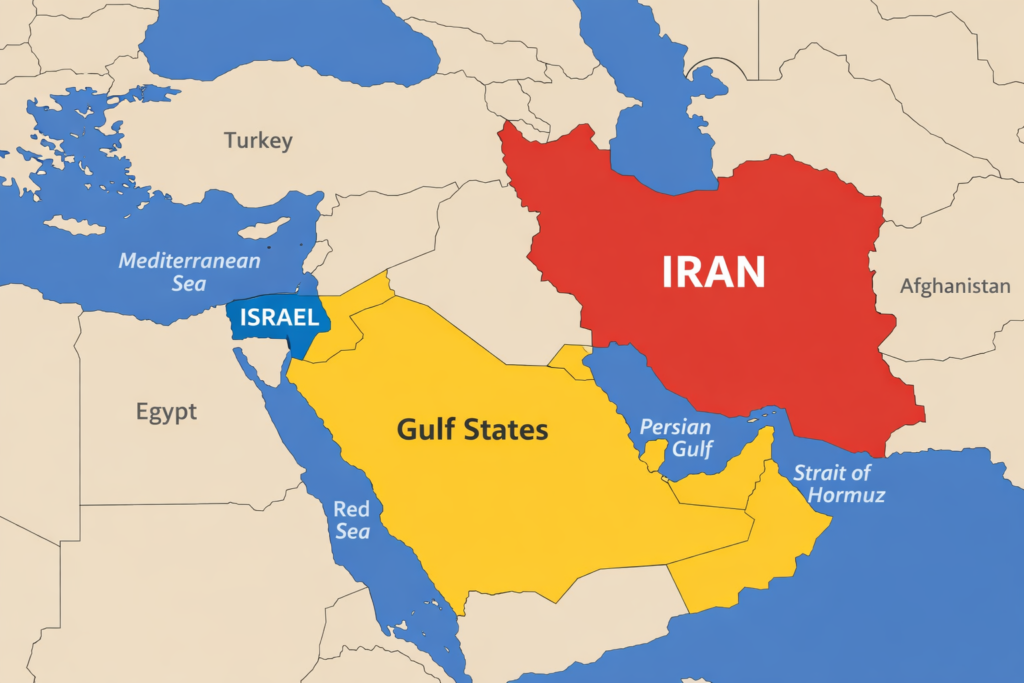
Iran, in turn, began retaliating with missile and drone attacks on Israeli territory and U.S. military bases across Gulf states. These exchanges have drawn in allied militia groups and expanded hostilities into neighboring regions.
What was once a shadow conflict — historically fought through proxies and diplomatic pressure — has now become a direct, kinetic confrontation.
This Is More Than A Middle East Issue – Here’s Why
1. The Strait of Hormuz Importance: Global Energy Security Is at Stake
When discussing Iran–Israel tensions, one term inevitably comes up: the Strait of Hormuz.
This narrow waterway connects the Persian Gulf to global shipping lanes and carries roughly one-fifth of the world’s oil supply.
That’s why the Strait of Hormuz importance cannot be overstated.
Since the escalation began, threats to maritime security have disrupted shipping patterns. Major carriers have rerouted vessels, insurers have withdrawn coverage, and overall risk around the strait has spiked.
When energy supply routes are even threatened — let alone restricted — global oil prices quickly react. This ripple affects transportation, manufacturing costs, inflation expectations, and investment decisions worldwide.
So even if this conflict stayed regional (and it may not), its impact on energy markets could touch consumers from Tokyo to Toronto.
2. Economic Ripple Effects
Connect energy markets to broader economic trends and you begin to see how geopolitical tension reshapes global markets.
Historically, geopolitical conflict tends to push investors toward safe haven assets — traditionally things like gold, U.S. Treasury bonds, or the U.S. dollar itself.
Simultaneously, stock markets can wobble, currencies can feel stress, and long-term investment flows become more cautious.
For developing economies that rely on energy imports, rising oil prices can translate into:
- higher inflation
- pressure on exchange rates
- widening trade deficits
- slower growth impulses
In simple terms: a ripple in the Middle East can feel like a wave in everyday markets.
3. Geopolitical Polarisation And Global Alignments
This isn’t just a military clash — it’s a geopolitical signal.
Powerful nations around the world have reacted in different ways:
- Russia and China have condemned the strikes and warned against escalation.
- Western powers have publicly supported the U.S.-Israel stance while urging de-escalation at the United Nations.
- Regional actors in the Gulf are forced to navigate between security concerns and strategic interests.
This polarization doesn’t just shape this conflict — it reshapes how alliances and diplomatic platforms will function for years.
4. Security Dynamics Across the Middle East
In response to the strikes, Iran has used allied groups — often referred to as the “Axis of Resistance” (including groups like Hezbollah, militias in Iraq and Syria, and others) — to widen the scope of retaliation.
The conflict in Lebanon between Hezbollah and Israel reflects this.
The result? This is no longer a bilateral conflict — it is a multifront, multilateral crisis, involving state and non-state actors across at least a half dozen countries.
Such complexity increases uncertainty and creates more “pressure points” for global security — from shipping lanes to diplomatic negotiations and alliance structures.
What This Means for the Everyday World
At the risk of oversimplifying, here’s the core takeaway:
This conflict is not just about geopolitics.It’s about global interdependence — for energy, finance, trade, and security.
If you’re someone who:
- pays an electricity bill
- travels by road or air
- invests savings
- sends money home
- worries about inflation
…then this matter affects you indirectly.
Oil prices go up → transport costs go up → inflation pressures rise. Shipping routes get disrupted → prices climb across sectors. Global markets tighten → risk assets wobble → currencies feel stress.
None of this requires a global thermonuclear event to matter. Just prolonged disruption is enough to affect millions of households.
Why This Isn’t Just “Another War Story”
Conflicts in the Middle East have been part of modern history for decades. But this moment feels different because:
- Direct involvement of global superpowers
- Wide regional reactions
- Critical global infrastructure at stake
- Highly interconnected global economy
And perhaps most importantly: this conflict happened at a time when global economic recovery is fragile, markets are already jittery, and energy systems are not as buffered as they once were.
That combination makes even temporary instability politically and economically potent.
Here’s the Conclusion (in simple terms):
This conflict isn’t just a headline — it’s a global node of change.
It doesn’t automatically mean “world war.”
But it does mean:
- countries will rethink alliances
- energy politics will shift
- markets will adjust
- economic planning will factor in new risks
And for you, the search for “what this means” makes sense — because this is one of those rare moments where geopolitics intersects directly with everyday life.
🌍 A Thought to Leave With
If global politics were once a distant academic topic for many of us, crises like this make it hard to ignore.The world doesn’t move in neat blocks anymore — it moves in networks of cause and consequence.
And being aware is not naïve — it’s necessary.
0 Comments